
What is the societal challenge?
The elimination of HIV as a public health threat is not possible without highly effective prevention strategies. Before 2010, HIV prevention was based almost entirely on condom promotion and reducing the number of sexual partners and HIV transmission rates were highly concerning.
HIV prevention medication taken regularly by HIV negative individuals (known as pre-exposure prophylaxis or PrEP) reduces the risk of acquiring HIV by more than 99 percent. However, in the early 2010s, uptake of this prevention strategy was slow.
How is the challenge being addressed?
In 2016, the Kirby Institute, in partnership with the NSW Ministry of Health, led an implementation trial called EPIC-NSW, which was the first study globally to test how well the rapid, targeted, population-scale implementation of PrEP would work in reducing HIV infection rates at community level.
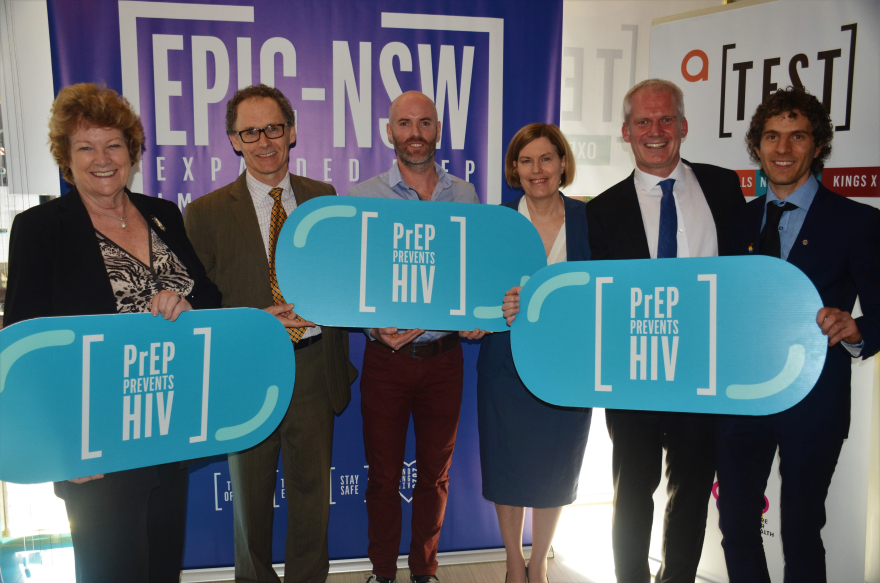
Former NSW Health Minister Jillian Skinner (right) with the Kirby Institute's Professor Andrew Grulich (second left) with partners on the EPIC NSW trial.
What are the outcomes and societal impact?
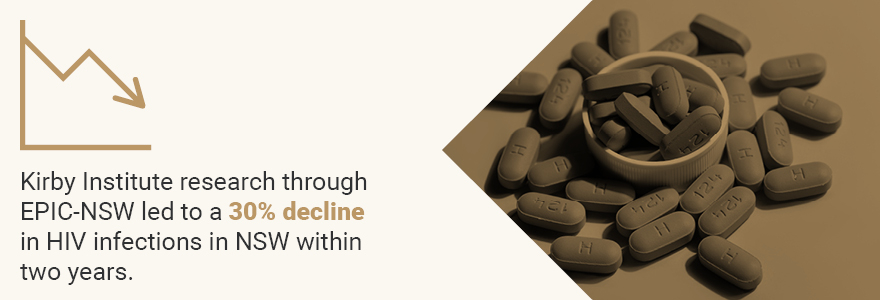
Kirby Institute research through EPIC-NSW led to a 30 percent decline in HIV infections in NSW within two years, demonstrating that targeted, at-scale, rapid implementation of PrEP quickly reduces new infections. This research provided an evidence base to inspire other countries to adopt PrEP quickly, targeted and at-scale.
This research led to PrEP medication being placed on the Pharmaceutical Benefits Scheme in 2018, allowing all people at risk of HIV – predominantly gay and bisexual men – in Australia to access PrEP affordably.
In addition:
- The proportion of eligible gay and bisexual men who received PrEP increased from 4 percent to 71 percent over the past decade.
- Over the same period, the increasing trend in HIV diagnoses in Australia was reversed, with a nationwide decline in annual HIV diagnoses of about 50 percent.
- In 2021, Australia reported its lowest ever numbers of new HIV diagnoses.
- In 2023, Kirby Institute research documented that inner Sydney is approaching the WHO HIV elimination threshold of a 90 percent reduction in new diagnoses, providing a proof of concept that elimination of HIV transmission is possible.
Karen Price was Deputy CEO at ACON at the time. ACON is the LGBTQ community health organisation who developed and implemented the community engagement and education aspect of EPIC-NSW. She says effective community engagement and demand creation was central to the success of EPIC-NSW and its ambitious goals.
“The combination of community leadership in the design and implementation of the study, as well as the actions taken by men in NSW, was fundamentally important in ensuring this critical HIV prevention tool got into the hands of as many of those who needed it, as quickly as possible.”