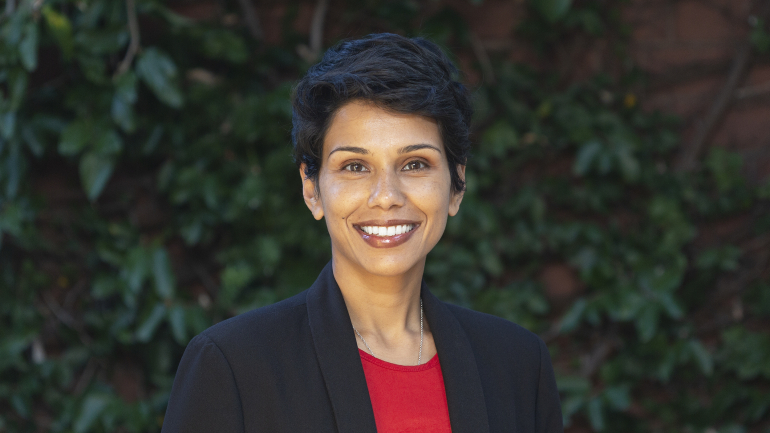


Infectious disease physician and inaugural David Cooper Scholar Dr Gail Cross has been awarded her Doctor of Philosophy (PhD) for her thesis focusing on the impact of administering an additional medication on the treatment of tuberculosis (TB).
Thanks to generous donations made in memory of the Kirby Institute’s inaugural director, the late Professor David Cooper AC, the scholarship was established to carry forward David’s vision of equitable access to health and his passion for knowledge exchange to train the next generation of researchers and clinicians. Dr Cross was awarded the scholarship in 2022.
Tuberculosis, a highly contagious bacterial disease affecting the lungs and other organs, is the world’s leading infectious disease killer. According to the World Health Organization, 10 million people fall ill with TB each year, and despite it being preventable and curable, TB causes 1.5 million deaths annually. It is also the leading cause of death of people living with HIV worldwide, due to compromised immunity.
“The current treatment regimen for TB is a 6-month course of four antibiotics, making it a major contributor to antimicrobial resistance,” explains Dr Cross. “Given there is a high burden of infection in many countries where resources are limited, there is an urgent need to develop shorter treatment options, and explore options to repurpose existing affordable, readily available medications.”
Dr Cross’ research explored the benefit of administering a short course of statins, a cholesterol-lowering medication, at the commencement of the standard antibiotic treatment in people with TB infection in Asia and Africa, via a multicentre randomised controlled trial. She discovered that a novel set of biomarkers revealed important new insights to understanding the effects of treating TB infection, opening the door to earlier and more accurate assessment of treatment response.
“TB is a fascinating disease in terms of its biology, as the organisms affect people very differently: with many people, symptoms are mild or non-existent, but for others, it can devastate them. We believe this has more to do with the individual makeup of the human, rather than the organism itself,” explains Dr Cross. “The potential impact of this research lies in advancing precision medicine approaches for TB by targeting the type of treatment to the individual, improving treatment outcomes and reducing disease burden.”
The findings of her research were published in first author publications in high impact journals including Lancet Infectious Diseases, Nature Communications, and The Journal of Infectious Diseases (JID), prior to the submission of her PhD. Although the statin treatment did not enhance TB clearance using current standard measures, Dr Cross’ research laid a path for future treatment development and innovation; crucially, the identification of the new biomarkers will optimise insights from future TB treatment research.
“Gail’s research has made important observations as to how tuberculosis treatment for people in low- and middle-income countries might be optimised through greater understanding of the underlying host biology and how it can be manipulated” says Kirby Institute Director, Scientia Professor Anthony Kelleher, who was Dr Cross’ co-supervisor. “The impact of her research is not only measured by her significant publications and thesis, but most importantly, will inform further discovery research to better understand what is a devastating global health challenge, and help develop accessible, lifesaving treatments.”
Research driven by shared humanity
Early in her career as an infectious disease physician, Dr Cross had an opportunity to work in Papua New Guinea for six months with the Walter and Eliza Hall Institute, to investigate whether and why so many people there had tuberculosis. She was faced with the devastation of TB on individuals and communities, and questioned why so little is understood about the disease, with increasing rates of resistance to the standard antibiotics, and little development in drug and diagnostic discovery in this field.
“As I wrote up the publication from that trip, I knew I would dedicate my life to TB research and would pursue a PhD to do this. There is so much for us to do to help communities affected by TB,” she says.
Through her dedication, both as a TB physician and now researcher, Dr Cross continues to be driven by the ethos that everyone should have access to good health, no matter their circumstances.
“TB is not just a biological disease; it is a disease of poverty and inequity. Although it is curable, countries who have eliminated it have done so largely through economic gain, so for me, this disease is a sentinel of all the things we have yet to understand about the human body, about the infection and about our shared humanity,” she says.
It is an ethos that aligns with Prof Cooper’s vision and approach to health as a human right, which inspired Dr Cross to apply for the David Cooper Scholarship. “My interests in social justice align very well with what Professor Cooper stood for, what he did, and what he achieved. I am so proud to have had the opportunity to carry that flag,” she says.
Dr Cross was co-supervised by Prof Kelleher, Professor Nick Paton at the National University Hospital, Singapore, and Cr Christina Chang from Monash University and The Alfred in Melbourne. Her thesis is titled ‘Rosuvastatin as host-directed therapy for drug-sensitive pulmonary tuberculosis’.