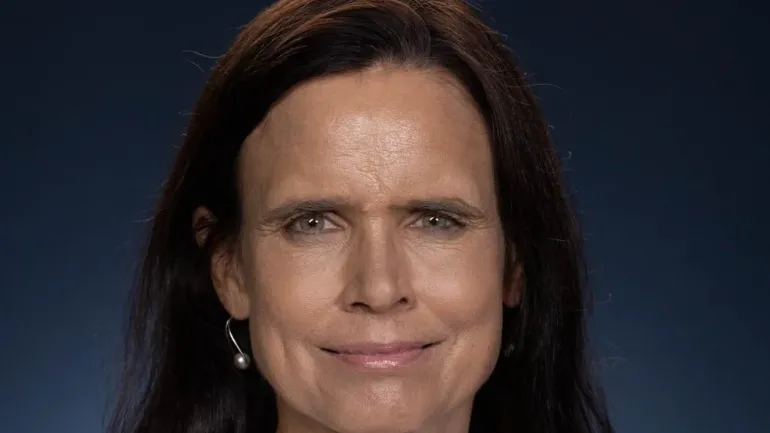


From witnessing bank robberies in Canberra to building a hospital in a region without running water, Stephanie Copus Campbell's 45 minutes behind the lectern at the Brett Tindall Memorial Lecture was packed with anecdotes that illuminated the pragmatism and charm which have clearly made her such an effective changemaker.
From 2022 to 2025, Stephanie served as Australia's Ambassador for Gender Equality. She is the founding Director of the Board of Femili PNG, an advocacy community organisation supporting survivors of sexual violence; and Director of the Board of City Pharmacy (CPL) Foundation PNG, a philanthropic organisation providing HPV-based cervical screening services for women in Port Moresby. She has led several development programs across the Pacific region, as well as holding several executive roles in Australia and internationally.
Evident from both her lecture and her impressively long CV, Stephanie's impact on the world of international development has been enduring. She reflected on the early days of her career, including the impact of our Patron, The Hon Michael Kirby AC CMG, whom she first encountered at a small community conference she organised in WA while working for the Red Cross.
"I do think probably I'm standing here today because you helped me start my career so many years ago," said Ms Copus Campbell.
A large part of her career has been spent in Papua New Guinea, where she first arrived in 2000. Her contributions there were recognised when she was appointed as a Member of the Order of Australia in 2021. It was also in PNG where she eventually would cross paths with Kirby Institute researchers in their shared efforts to eliminate cervical cancer as a public health threat to the country.
Stephanie unpacked the unique challenges of strengthening the public health infrastructure of a nation with a highly dispersed and remote population.
"About 85% of the population live in rural areas and about a million of those live in communities that are so remote it may be a three day walk to a health station."
She didn't shy away from scrutinising the profound impact that gender inequity had on progress, citing its influence on domestic and family violence rates, healthcare access and employment opportunities.
The anecdotes she shared from her time in PNG served as case studies in how meaningful public health impact can be achieved in even the most challenging circumstances. Stephanie recounted the journey towards the establishment of a new provincial health district in the remote Hela province, up against a severely under-resourced healthcare workforce, natural disasters, a rapidly growing population, high rates of domestic violence and civil unrest.
She acknowledged the Kirby Institute's partnerships in PNG and the real impact that cervical cancer elimination efforts are making on the ground. Nods went around the room as she discussed the insidious threat that cervical cancer continues to pose.
"I've personally known five women who have died of cervical cancer, a disease which should kill no one."
Stephanie played a key role as an advocate in initial discussions between the Kirby Institute and Swire Group that culminated in the largest single donation in UNSW's history at the time, $25.9m, to advance cervical cancer elimination in the Pacific. She played a similar role in the establishment of a new partnership between UNSW and the Santos Foundation, resulting in $3.4m in philanthropic support towards the Kirby Institute’s elimination program in PNG.
Later that day, Stephanie was awarded an honorary Doctorate of Health Care by UNSW in recognition of her accomplishments as an internationally recognised leader in gender equity and global public health, and an outstanding advocate and public supporter of UNSW Sydney and the Kirby Institute.
"Stephanie's track record aligns with our own values at the Kirby: Equity, Impact, Collaboration and Excellence. That’s why we are honoured to have her join a group of distinguished guest speakers who have previously delivered our annual Brett Tindall Memorial Lecture," said Kirby Institute Director, Anthony Kelleher.
The Brett Tindall Memorial Lecture is an annual lecture awarded by the Kirby Institute to a leader in infectious disease research, policy, and/or community advocacy.
It is awarded in memory of Dr Brett Tindall, who was one of the Kirby Institute’s first researchers in the 1980s. Brett's research focused on the process of seroconversion and the body's responses to the entry of HIV. He died of AIDS in 1994.