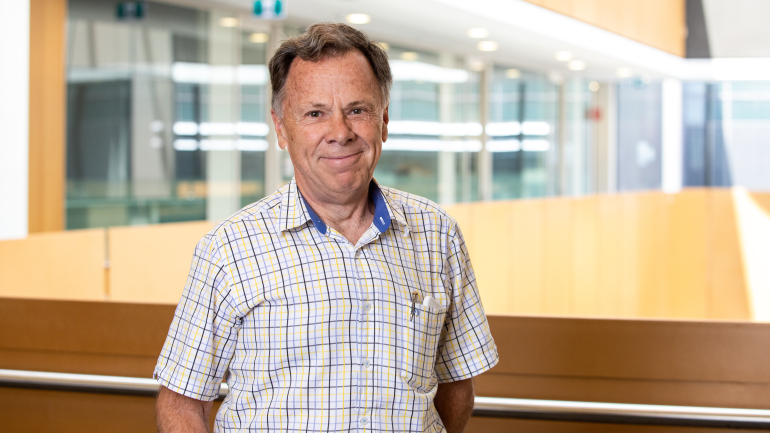


Ahead of his retirement, colleagues, friends and family gathered in the Kirby Institute Seminar Room in celebration of the illustrious career of clinician-researcher Professor Andrew Lloyd AM, Head of the Kirby Institute’s Viral Immunology Systems Program (VISP).
At the event, Kirby Institute Director Scientia Professor Anthony Kelleher announced that upon his retirement, Prof Lloyd was being conferred the title of Emeritus Professor.
Andrew’s work has had a significant impact on the policy and practice of infectious diseases. His research is remarkable for its breadth – ranging from public health to clinical trials and to immunovirology, with a focus on hepatitis C, particularly among people in prison, as well as the challenging and enigmatic clinical condition of post-infective fatigue. In more than 40 years of clinical research, he has mentored dozens of students and researchers, contributed to key research breakthroughs, and shaped health care practice.
In his introductory remarks, Anthony emphasised Andrew’s ability to synthesise expert, sophisticated laboratory science with needs-based implementation research; the translational approach to research for which he became well known. On his extensive and world-leading hepatitis C research within prisons, Anthony noted that Andrew “has looked at ways of innovating in that challenging environment, making sure that people in those systems have access to diagnosis and the best treatment available.
“Andrew has made extraordinary contributions over many years across a spectrum of science, and has done so in a very thoughtful manner,” he said.
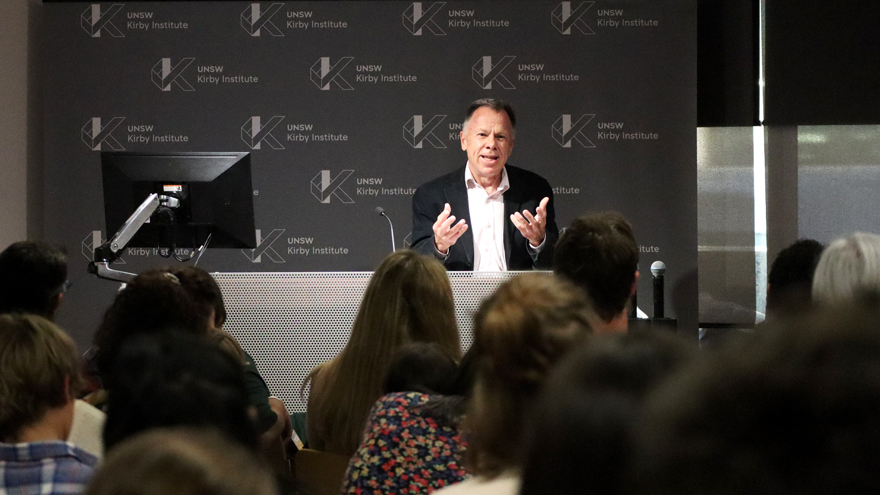
Emeritus Professor Andrew Lloyd AM speaking at the lectern.
40 years of research, health delivery and mentorship
Andrew’s association with UNSW dates back to 1990, and following a three-year Fellowship at the National Institutes of Health (NIH) in the United States, he returned to UNSW on a conjoint appointment with the nearby Prince of Wales Hospital, and became a permanent UNSW academic in 1997. He joined the Kirby Institute in 2016.
Throughout his time at UNSW, Andrew honed his infectious disease research expertise, underpinned by his basic science background, and was instrumental in growing what is now the UNSW School of Biomedical Sciences, as well as founding the UNSW Fatigue Clinic in 2007, which integrated clinical services and research for an under-researched and not well understood condition in medicine.
Andrew’s colleague and friend, Professor Nicodemus Tedla, has studied under and worked alongside Andrew since 1993, and recounted his exceptional and expansive career.
He noted a number of significant contributions of Andrew’s to the understanding of hepatitis C, and improving the health of those living with it. He led the establishment of the Hepatitis Service in NSW prisons, a service which became a blueprint nationally and internationally for health service delivery in prisons, as well as the cross-sector Australian National Prison Hepatitis Network. He has also contributed extensively to NHMRC and other government boards and panels, with his hepatitis C, and more recently, post-infection fatigue syndrome research and clinical practice contributing to national and international policy.
Notably, he was awarded a Medal of the Order of Australia (AM) in 2002 for his hepatitis C clinical work in prisons and broader infectious disease research.
Beyond his research, though, Andrew has built his career on caring for others through his clinical practice within the prisons, through the UNSW Fatigue Clinic, and at Prince of Wales Hospital.
“Andrew takes very challenging topics, or topics that affect the underprivileged, and that actually shows you how deeply he cares for the clinical outcomes of everyone; especially the ones who are overlooked,” said Nicodemus.
Corrections, infections & career reflections
Commencing his address by paying tribute to his wife, Andrea, and four children, Eva, Rebecca, Simon and David, as well as his seven grandchildren, Andrew shared anecdotes that illustrated key lessons and reflections from his expansive career.
From spending a lot of his childhood in Papua New Guinea, and returning to spend an elective medical term as a young clinician, Andrew recalled how his experience there set him on the path of infectious diseases. Having treated a very unwell patient with cerebral malaria and witnessing her remarkable recovery, he said “that experience really cemented for me what I thought might be good to do as a career – infectious diseases clinical practice – as a great opportunity to do good for the individual. And so I thought, this is it, I’m on my road for infectious diseases.”
He went on to highlight some key experiences and people who punctuated his career as a clinician researcher. From his time as a young clinician when the HIV epidemic struck in the 1980s, caring for gay patients of a range of backgrounds, many of whom had not come out as gay to their families, Andrew learned that “infectious diseases is not only about wonder drugs and cure, but about providing relief in very difficult circumstances.”
He became interested in challenging himself and honing his expertise and interest in infectious diseases beyond the clinic and into research, and the topic for his PhD was “shaped a little bit by the serendipity or the circumstance of two patients consecutively that came to the outpatient infectious diseases clinic.” Both patients were young people who had lingering, debilitating post-viral fatigue. Whilst through his PhD research he ruled out a wide range of physiological and psychiatric causes of post-infective and chronic fatigue, Andrew was set on a lifelong journey and interest in the condition, and caring for those with it, which he points out “is equally enigmatic now as it was back then.”
He went on to expand his research expertise into the laboratory, embracing new skills and technologies that would take him to the National Institutes of Health in the USA. He then shared about his entry into hepatitis C research in prisons – a priority setting for the elimination of hepatitis C as a public health threat. Andrew was one of the first people to ‘take the healthcare to the patient’ in that setting, avoiding the resources and time involved in moving prisoners to external services. With his Kirby Institute colleague, Scientia Professor Gregory Dore, he set up a major study rolling out hepatitis C ‘treatment as prevention’ in prisons in NSW, with the support and endorsement of Deputy Commissioner Luke Grant from NSW Corrective Services, who helped navigate the many bureaucratic layers and departments involved in setting up what would become an extremely successful study. It reduced hepatitis C infections in prisons by half, demonstrated prisoners’ positive uptake of testing and treatment, and set a blueprint for hepatitis C health service delivery in prisons nationally and globally.
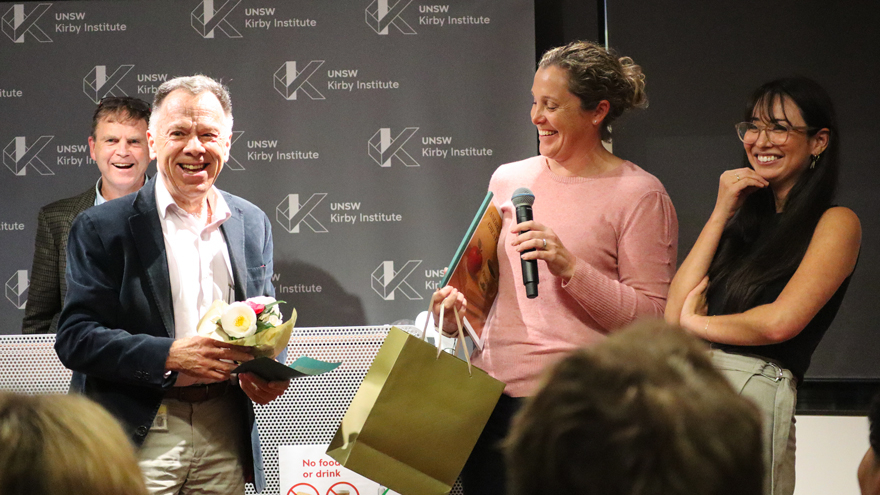
Emeritus Professor Andrew Lloyd AM receving gifts from Rowena Bull and Yumi Sheehan.
Tributes to a beloved mentor
To conclude the event, three of Andrew’s mentees, each of whom will take on leadership of an aspect of his research remit, paid tribute to his mentorship.
Professor Rowena Bull, who will take on his laboratory work and student supervision, Dr Carolina Sandler, who takes on the UNSW Fatigue Clinic management, and Dr Yumi Sheehan, who will take on the hepatitis C in prisons portfolio, all spoke of Andrew’s sage professional guidance, and personal commitment and support as a mentor to the next generation.
“I think the most important lesson I’ve learnt from you is that if we can give people the time and support they need, they will get there, and they will thrive. I hope that’s something I can continue to emulate with my own mentorship,” said Rowena.
Andrew’s wife, Andrea Lloyd, paid tribute to ‘the man behind the microscope’, sharing that his support of and love for his family, often expressed through the pragmatism of a clinician-scientist, and always underpinned by a sense of humour, shaped their family life.
“Thank you, Andrew, for the science, the sawdust, and the steady hand. You've taught our family how to think critically, build thoughtfully, breathe calmly through chaos,” she said.