


The Kirby Institute’s Dr David Khoury has been awarded the Frank Fenner Prize for Life Scientist of the Year at the 2025 Prime Minister’s Prizes for Science.
Speaking in the Great Hall at Parliament House in Canberra last night, Prime Minister Anthony Albanese said scientists were tackling some of Australia’s greatest challenges. “Tonight is a chance to truly celebrate the achievements of individuals, and to celebrate who we are as a nation,” he said. “Looking at the next few decades, it is Australian science that has so much to contribute to the world that we know is just around the corner.”
The Frank Fenner Prize for Life Scientist of the Year is awarded to an individual for an exceptional achievement in life science that benefits, or has the potential to benefit, human welfare or society.
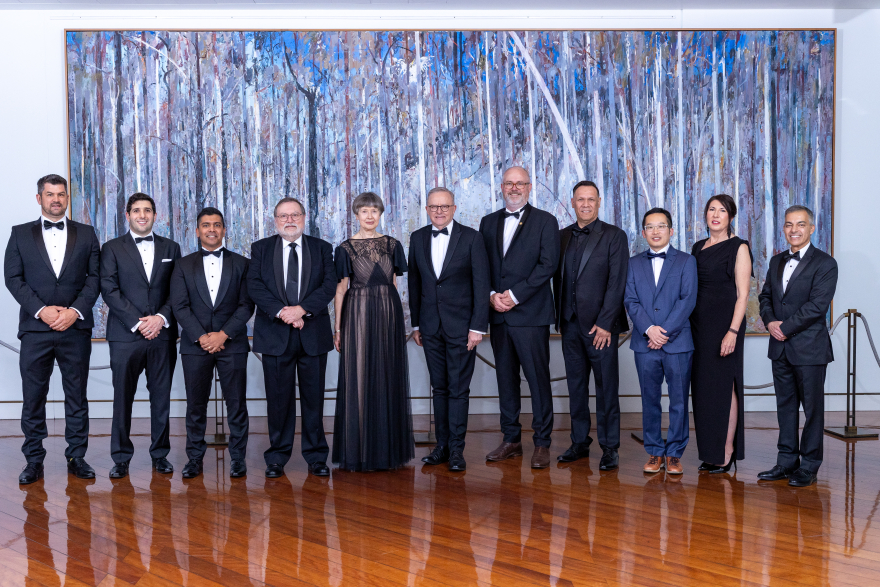
Prime Minister Anthony Albanese, Minister for Science Tim Ayres, and recipients of the 2025 Prime Minister's Prizes for Science. Dr David Khoury is second from left. Credit: Department of Industry, Science and Resources.
Dr Khoury received the Prize for using applied mathematics to translate laboratory results to provide evidence-based predictions of clinical outcomes. His work has guided drug and vaccine development, assessment and deployment decisions for established and emerging infectious disease threats including COVID-19, mpox, and malaria.
When talking about what drives his research, Dr Khoury says: “My passion is applying maths to laboratory science to help make important real-world decisions that can change people's lives. It has enabled faster development and deployment of life-saving treatments and vaccines.”
Dr Khoury’s expertise and innovative methods are regularly sought and cited by industry, government and organisations including the World Health Organization (WHO). He was the first person in the world to identify a key measure of immune protection for COVID-19. His discovery influenced national and international policies about vaccine deployment and boosters, including the US Food and Drug Administration’s (FDA’s) approval of COVID-19 vaccines for children.
He also developed models for antimalarial drug testing and provided critical insights to inform international vaccine policy to combat mpox; his work has helped guide mpox vaccine policy by linking the immune response and protection against mpox after vaccination.
The award was presented by Minister for Science Tim Ayres, who said he was delighted to celebrate some of Australia’s most talented researchers. “All of tonight’s recipients are making their own significant contributions to Australian science,” he said. “They’re drawing on different scientific disciplines and driving uniquely Australian achievements that really matter.”
Kirby Institute Director, Scientia Professor Anthony Kelleher, attended the Prizes ceremony and congratulated Dr Khoury. “This is an outstanding recognition of David’s globally impactful application of mathematical modelling to understand complex biological phenomena, providing accessible and widely applicable answers to major challenges in infectious disease. His work has had a significant and direct impact on international policy for COVID-19 and mpox vaccination, and for antimalarial drug testing. His research is translational in the truest sense of the word, and its direct impact on the health communities across the globe cannot be overstated.”
“To receive the Frank Fenner Prize for Life Scientist of the Year is an absolute honour and privilege,” says Dr Khoury. “It recognises the hard work that my family put in to help me through school, and now the team and collaborators I work with, without whom the work that I do wouldn't be possible.”
The Prime Minister’s Prizes for Science are Australia’s most prestigious and highly regarded science awards, and celebrate demonstrated achievements in scientific research, research-based innovation, the practice of Aboriginal and Torres Strait Islander knowledge systems and excellence in science teaching.